


History
1863: Building application of the cafetier Peters for a four-story residential building and a dance hall.
1865–1873: First problems in getting permission to use the dance hall for e.g. theatre performances because the width of the passage and the escape routes do not comply with building regulations. The owner of the house changes several times.
1874–1922: Ferdinand Renz takes over the hall business, which is continued by his family under the name Graumann’s Festsäle.
1876: A fire A fire of unknown cause destroys the Ballhaus down to the beams. Under the direction of the architect A.E. Witting, reconstruction begins in the same year.
1904: The owner Graumann struggles with the responsible authorities for permission to erect a music podium. Only after long negotiations is the ban lifted, when Grauman declares in writing that the podium should only serve „(…) to give teachers and lecturers the opportunity to deliver a Kaiserhoch etc. from an elevated position on festive occasions and also to be able to give other lectures. (…) The more, my halls do not serve the public in any direction, neither public dance, theater, merrymaking, nor public meetings, my rooms are only rented to closed societies, warrior clubs, social, scientific, church parochial societies, wedding societies, etc. (…)“
1922: Wilhelm and Elise Döring become owners of the hall and give thw Ballhaus its name. Building regulations still restrict the operation. The Döring’s are – until the 1950s– in constant conflict with the responsible authorities; only in exceptional cases public events are approved. The hall is therefore mainly rented to closed societies.
1934: The store in the front building is converted into a restaurant; now the hall can be reached through a massively build connecting corridor.
1937: The magarine companies Rama and Sanella organize advertising film screenings which, according to contemporary witnesses, are very popular for several weeks.
1938: The hall building is taken over by the „Reichshauptstadt Berlin“. During the war, forced laborers are housed here, who are used, among other things, in the construction of the Fichte-Bunker. More is not yet known about the use of the Ballhaus during the Second World War.
1945: The Ballhaus survives the war relatively undamaged. Already in the winter of 1945/46, there is regular music and dancing in Döring’s ballrooms, but also public lectures and political meetings. In 1949, Elise Döring finally even receives the official dance permit.
1961: The operation of the hall is abandoned, the building is rented out as a storage room. The restaurant in the front building often has new tenants.
1970: Die BeWoGe (Berliner Wohn- und Geschäftshaus-Gesellschaft) acquires the property and plans demolition and new housing construction.
1972: Monument conservators discover the Ballhaus during a site inspection in the Kreuzberg redevelopment area and campaign for its preservation.
1979: The Ballhaus is extensively restored by the Berlin State Conservator with funds from the Federal and State Governments.
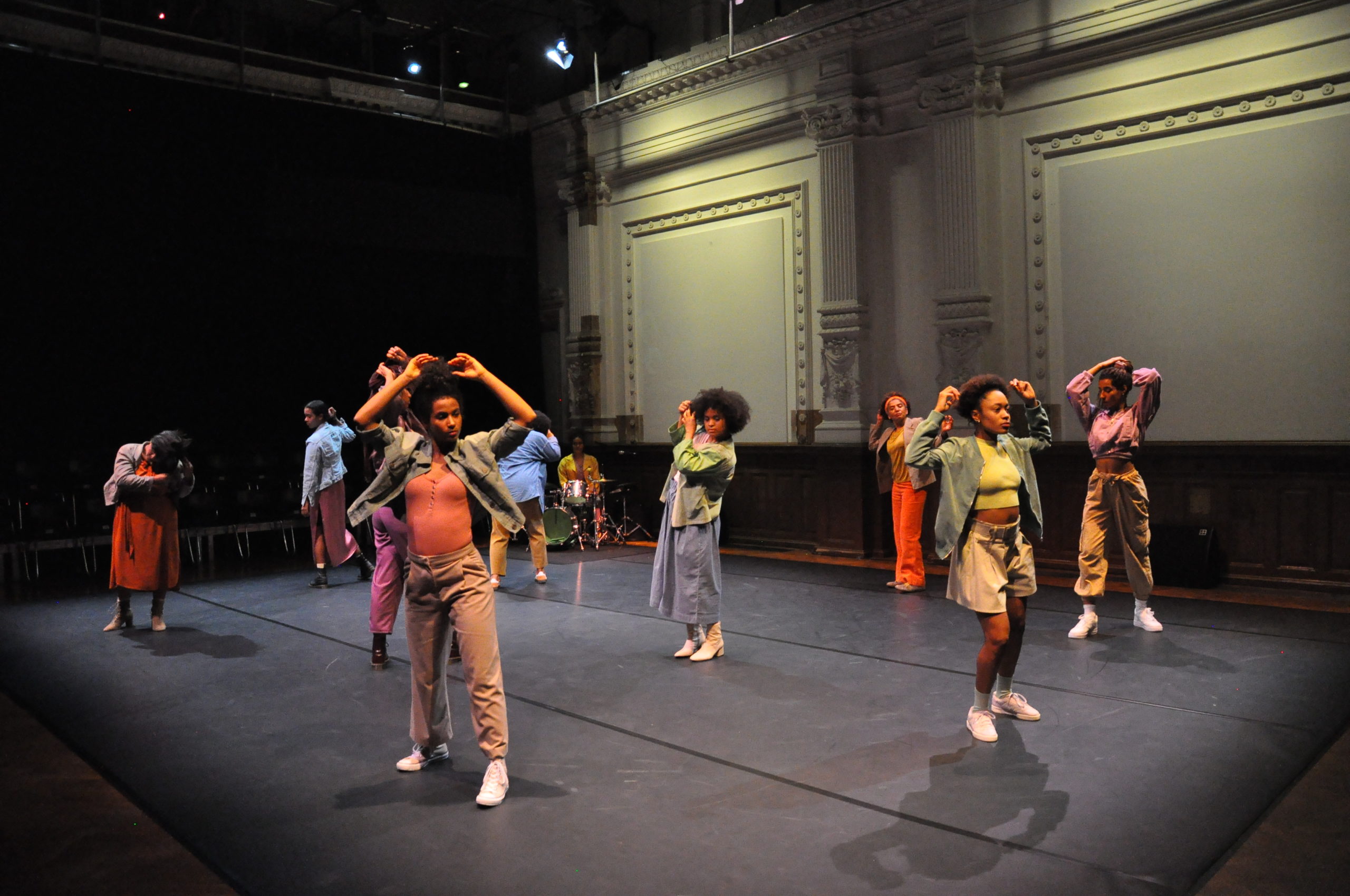
1983: Since 1983, the Ballhaus has been owned by the Kreuzberg District Office and operated by the Kreuzberg Art Office as a public cultural center.
From 2008 until the end of 2012, the gemeinnützige Kultursprünge e.V. was in charge of the Ballhaus Naunynstraße, with which the district office concluded a cooperation agreement for the period 2008-2012. Since its entry into the commercial register on March 18, 2013, the non-profit Kultursprünge GmbH has been running the operational business of Ballhaus Naunynstraße and is the contractual partner of the district office of Friedrichshain-Kreuzberg.
Since 2020 the gemeinnützige Kultursprünge GmbH has been funded by the State of Berlin, the Senate Department for Culture and Europe, and the Friedrichshain-Kreuzberg District Office.