

Republik Repair
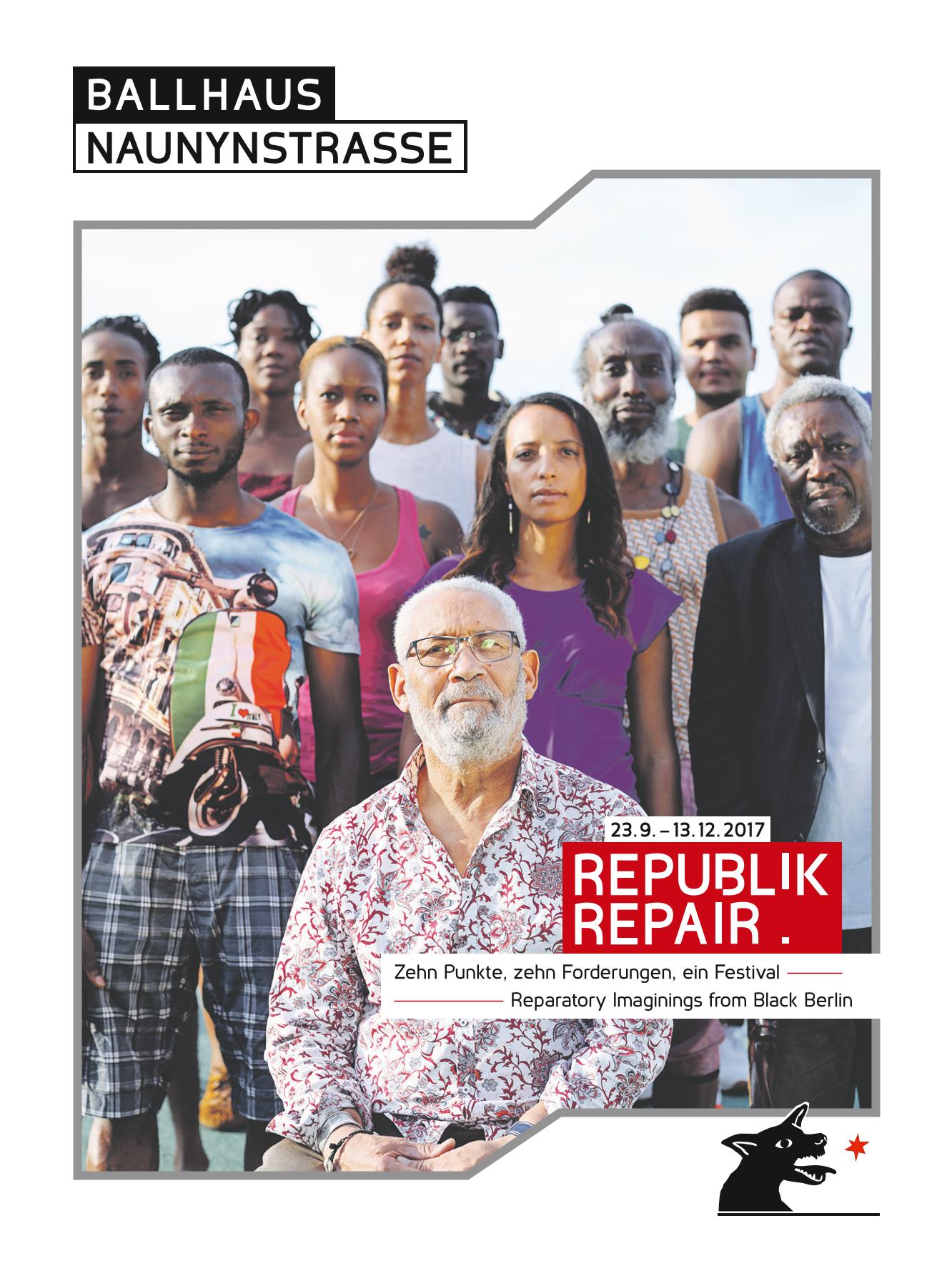
Republik Repair opens up space for new interpretations of the demands for reparations and reparative forms. The starting point for this is our living situation here in Berlin, Germany and Europe. Politically and performatively, the programme translates decolonized healing and repair methods for our communities.
Republik Repair responds to the transnational call for reparations and justice with a series of theater, film, dance, performance, literature and discussion events in Berlin, at Ballhaus Naunynstraße. The festival invites Black artists, activists, scholars and performers to imagine and occupy reparatory spaces and acts as a forum for our own demands for reparations.
A 10-point action plan provides a framework for this provocative festival of black perspectives. It is based on the catalog of demands of the Community of Caribbean States (CARICOM). In it, they call on the former colonial states to make significant efforts in ten areas of society to overcome the grievances that can be traced back to enslavement and colonialism. Republik Repair assumes that these ten points, even if they relate to Caribbean conditions, are relevant to all black people and their issues worldwide. Here in Berlin, those of us who identify as Black - despite the scars of historical injustice that still impede our access to equality, participation and recognition - find creative approaches to living in relative freedom. Republic Repair envisions the potential of this energy if these barriers were to fall, if they were to fall worldwide.
CARICOM's 10-point plan for reparations and justice offers an impressive structure that can be developed further, for example by thinking through which demands can be derived from female and queer Black experiences. The diversity of Black Berlin puts Republik Repair in a unique position to open up the conversation about reparations to intersectional perspectives. Through panel discussions, the festival creates space for debates on political strategies of empowerment, liberation and political representation. For example, the event Genocide has no statute of limitations invites members of the Nama Genocide Technical Committee and the Ovaherero Genocide Foundation to discuss how we can support the demand for a comprehensive formal apology - the first demand of the CARICOM plan - and reparations for the first genocide of the 20th century.
Germany Learns to Read turns the demand for literacy on its head - it is the institutions and structures in Germany that have to learn, that have to overcome their illiteracy towards colonial history and its effects. As we must work to stop our governments' past practices of Debt as Governance, we address debt relief; and we speak with Indigenous groups about common forms of resistance to displacement, denial and erasure. Prof. Verene A. Shepherd, Vice President of CARICOM and new Director of the Centre for Reparations Research, will report on the current status of reparations claims. It is time to ask how the debtors who benefited from domination over others should be paid and how our republics can be healed.
There are many resonances at Republik Repair - the rhythms and beats of these themes, ideas and methods resonate between artists and performances in the program, but also with past events and festivals at Ballhaus Naunynstraße. A common thread is the idea of archives as part of reparation, whether it is plants (Right to Mourn, Right to Monument), personal collections of historically important ephemera (Sankofa BRD/ Sankofa DDR), bodies (Unrestricted Contact) or the way we meet and organize ourselves (Resistance to Erasure, Methods of Belonging). The recognition of oral history as a legitimate document of experience and history is the underlying premise of the public reading Die Gelegenheit, the Republik Repair edition of the Kiezmonatsschau of the akademie der autodidakten, the musical prose of Matondo and Amewu, the Listening Workshop and the podium jam session Pepperpot. Both the opening theater production Walking Large and the Movement Happenings explore in different ways our individual and collective steps as black people, and how our stance can literally and figuratively take up space in this society. The neologism Blackognitions announces a series of experimental film installations that address different perceptions of blackness. The artwork We Returned the Burdens That We Bore to Their Rightful Owners, Having Realized That We Never Owed Them a Thing also engages with this on a personal level by portraying what the Black subject owes themselves. This resonance between works and events is a way of claiming space. The idea of building living environments for ourselves is common to many of the contributions - how and why we as Black people create space for ourselves to live and share our ways of being and knowing.
Republik Repair does not emerge in a vacuum - it is a product of what preceded it at Ballhaus Naunynstraße with the festivals Black Lux and We Are Tomorrow, and of what is yet to come. Black perspectives cannot be sustained on a linear temporality, because Blackness has a lot to do with a capitalist worldview that existed before any of us were born, and it is sustained by the eternal hope for a better future based on a correction of this external view. So we are time travelers, even if we sit still.
Imaginings are a workshop, a studio or a greenhouse - spaces where healing methods can be brought into other contexts and reworked to create new ways of thinking and communicating. When applied to political conditions, these new perspectives can be "reparatory". When shared, these imaginings and blueprints become concrete evidence and testimonies on the road to reparations.